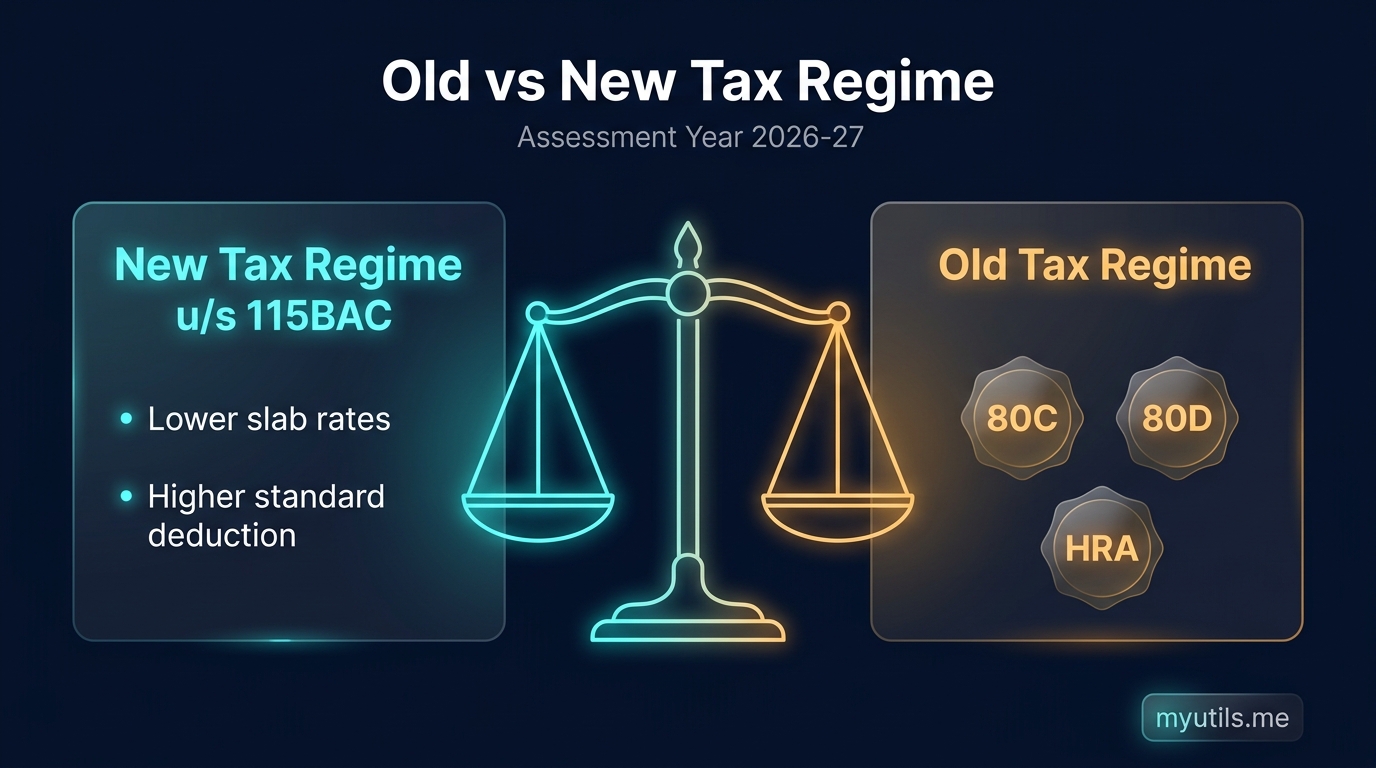

Deciding whether to stick with the Old Tax Regime or embrace the New Tax Regime (Section 115BAC) is the single most critical financial choice Indian taxpayers make each assessment year.
For Assessment Year 2026-27 (Financial Year 2025-26), the government has substantially overhauled the New Tax Regime to make it compelling for middle and high-income earners:
- Basic Exemption Limit Raised to ₹4,00,000 (up from ₹3,00,000).
- Section 87A Rebate of ₹60,000: Resident individuals with taxable income up to ₹12,00,000 pay ZERO income tax.
- Enhanced Standard Deduction of ₹75,000: For salaried employees, standard deduction is ₹75,000 under the New Regime (compared to ₹50,000 in the Old Regime).
- Effective Tax-Free Salary of ₹12,75,000: A salaried taxpayer earning up to ₹12,75,000 owes ₹0 in tax under the New Regime!
- Revised, Wider Slabs: New tax brackets of 5%, 10%, 15%, 20%, 25%, and 30% structured in clean ₹4 Lakh intervals.
However, if you service a large home loan, pay high house rent in metro cities, and maximize Section 80C, 80D, and NPS contributions, the Old Tax Regime may still be beneficial in select circumstances.
Here is the definitive guide and mathematical break-even breakdown for choosing the right regime in AY 2026-27.

Side-by-Side Tax Slab Comparison (AY 2026-27)
The revised statutory tax slabs for Assessment Year 2026-27 (Financial Year 2025-26) are structured as follows:
| Income Range | New Tax Regime (Default u/s 115BAC) | Old Tax Regime (Optional u/s 115BAC(6)) |
|---|---|---|
| Up to ₹2,50,000 | Nil | Nil (₹3L for Senior Citizens, ₹5L for Super Senior) |
| ₹2,50,001 to ₹4,00,000 | Nil (Basic exemption ₹4 Lakh) | 5% (Rebate u/s 87A applies up to ₹5L) |
| ₹4,00,001 to ₹5,00,000 | 5% (Rebate u/s 87A applies up to ₹12L) | 5% (Rebate u/s 87A applies up to ₹5L) |
| ₹5,00,001 to ₹8,00,000 | 5% (Rebate u/s 87A applies up to ₹12L) | 20% |
| ₹8,00,001 to ₹10,00,000 | 10% (Rebate u/s 87A applies up to ₹12L) | 20% |
| ₹10,00,001 to ₹12,00,000 | 10% (Rebate u/s 87A applies up to ₹12L) | 30% |
| ₹12,00,001 to ₹16,00,000 | 15% | 30% |
| ₹16,00,001 to ₹20,00,000 | 20% | 30% |
| ₹20,00,001 to ₹24,00,000 | 25% | 30% |
| Above ₹24,00,000 | 30% | 30% |
Note: Surcharge (capped at 25% under the New Regime vs 37% in the Old Regime) and Health & Education Cess (4%) apply additionally across both regimes.

Major Differences in Deductions and Exemptions
The New Tax Regime trades away itemized deductions in exchange for significantly lower slab rates and a much higher tax-free threshold:
| Exemption / Deduction Head | Old Tax Regime | New Tax Regime (AY 2026-27) |
|---|---|---|
| Basic Exemption Limit | ₹2,50,000 | ₹4,00,000 |
| Standard Deduction (Salaried) | ₹50,000 | ₹75,000 |
| Rebate u/s 87A | Up to ₹12,500 (Income up to ₹5,00,000) | Up to ₹60,000 (Income up to ₹12,00,000) |
| Effective Tax-Free Salary | ₹5,50,000 (₹5L + ₹50k std ded) | ₹12,75,000 (₹12L + ₹75k std ded) |
| Section 80C (PPF, ELSS, EPF, LIC) | Up to ₹1,50,000 | Disallowed (₹0) |
| Section 80D (Health Insurance) | Up to ₹25,000 / ₹50,000 / ₹1,00,000 | Disallowed (₹0) |
| HRA u/s 10(13A) (House Rent) | Full statutory exemption | Disallowed (₹0) |
| Home Loan Interest u/s 24(b) | Up to ₹2,00,000 (Self-occupied) | Disallowed (₹0) |
| Employer NPS u/s 80CCD(2) | Allowed up to 10% (14% for Govt) | Allowed up to 14% of salary |
| Family Pension Deduction | Up to ₹15,000 | Up to ₹25,000 |
Tired of Logging into the Tax Portal for Every Single PAN?
Track all your client and family ITR refund statuses, intimation notices, and AIS summaries from one clean, automated dashboard.
The ₹12.75 Lakh Zero-Tax Calculation & Marginal Relief
Under the New Regime, how does a salaried individual earning ₹12,75,000 pay zero tax?
| Step / Calculation Head | Formula & Slab Rates | Amount |
|---|---|---|
| Gross Salary Income | Baseline annual salary | ₹12,75,000 |
| (-) Standard Deduction | Section 16(ia) standard allowance | - ₹75,000 |
| Net Taxable Income | Salary after standard deduction | ₹12,00,000 |
| Up to ₹4,00,000 | 0% slab rate | ₹0 |
| ₹4,00,001 to ₹8,00,000 | 5% on ₹4,00,000 | ₹20,000 |
| ₹8,00,001 to ₹12,00,000 | 10% on ₹4,00,000 | ₹40,000 |
| Total Slab Tax Before Rebate | Cumulative slab tax | ₹60,000 |
| (-) Section 87A Rebate | Full statutory rebate (income ≤ ₹12L) | - ₹60,000 |
| Final Net Tax Payable | 100% Tax-Free Take-Home | ₹0 |
What If Your Income Slightly Exceeds ₹12 Lakh? (Section 87A Marginal Relief)
If your net taxable income is ₹12,10,000 (₹10,000 above the rebate threshold), your calculated slab tax would normally be ₹61,500. Under Marginal Relief on Rebate, the tax payable cannot exceed the amount by which your income exceeds ₹12,00,000. Therefore, your tax payable is capped at ₹10,000 (+ 4% cess = ₹10,400), preventing an unfair tax spike.
The Break-Even Analysis: Statutory Slabs & Surcharge Marginal Relief
To determine which regime is better for your salary, compare your eligible deductions under the Old Regime against the break-even deduction required for your income:
Total Deductions = Standard Deduction (₹50,000) + Itemized Deductions (80C + 80D + HRA + Home Loan Interest)If your total eligible deductions exceed the Break-Even Threshold, the Old Regime saves you more tax. If your deductions fall below the threshold, the New Regime is superior.
The ₹24.75 Lakh Universal Threshold (Salaries from ₹24.75L to ₹50L)
Tax planning should follow the exact statutory slab bracket transitions of Section 115BAC (accounting for the ₹75,000 standard deduction):
- Both Regimes in the 30% Slab: - Under the New Regime, the top 30% tax slab begins at taxable income above ₹24,00,000 (gross salary above ₹24,75,000 for salaried employees). - Under the Old Regime, the top 30% slab begins at taxable income above ₹10,00,000.
- Fixed ₹2,40,000 Base Tax Difference: - For any gross salary between ₹24,75,000 and ₹50,00,000 (where no surcharge applies), the difference in base tax between the two regimes is permanently fixed at ₹2,40,000 (or ₹2,49,600 including 4% cess). - Because each rupee of deduction under the Old Regime shields income at the 30% rate, wiping out this ₹2,40,000 base tax difference requires: - Itemized Deductions Needed: ₹2,40,000 ÷ 0.30 = ₹8,00,000 - Total Deductions Needed: ₹8,00,000 + ₹50,000 standard deduction = ₹8,50,000
The Universal Constant: For every salaried taxpayer earning between ₹24,75,000 and ₹50,00,000, the break-even deduction required to beat the New Regime is permanently fixed at ₹8,50,000 in total deductions (₹50,000 standard deduction + ₹8,00,000 in itemized deductions).
How Surcharge & Statutory Marginal Relief Shift the Break-Even Above ₹50 Lakh
For salaries above ₹50 Lakh, the break-even deduction does not remain static at ₹8.5 Lakh. It shifts dynamically due to Surcharges and Statutory Marginal Relief:
- Marginal Relief Window at ₹50 Lakh (10% Surcharge): - Crossing ₹50 Lakh taxable income triggers a 10% surcharge on total tax. - Statutory Marginal Relief caps total tax and surcharge so that the additional levy cannot exceed 100% of the income earned above ₹50 Lakh. - Within this marginal relief window (e.g. gross salary of ₹51 Lakh), excess income in the New Regime is taxed heavily under the relief cap. However, in the Old Regime, claiming deductions pulls taxable income safely below ₹50 Lakh, completely avoiding the surcharge. As a result, the break-even deduction required temporarily dips below ₹8.5 Lakh (to ~₹7.92 Lakh total / ₹7.42 Lakh itemized at ₹51 Lakh salary).
- Higher Surcharge Windows (₹1 Crore & ₹2 Crore): - Surcharge steps up to 15% at ₹1 Crore and 25% at ₹2 Crore. At each threshold, statutory marginal relief applies across a transition window, altering the precise break-even deduction.
- The ₹5 Crore Surcharge Chasm (37% Old vs 25% New): - Above ₹5 Crore, the New Regime caps surcharge at 25%, whereas the Old Regime levies a punitive 37% surcharge. This 12% surcharge disparity makes the Old Regime overwhelmingly expensive, pushing the break-even deduction required to astronomical levels.
Break-Even Deductions at Each Statutory Slab Transition
| Gross Salary Bracket | Statutory Slab Transition Point | New Regime Base Tax | Old Regime Break-Even Total Deductions | Itemized Deductions Needed (Excl. ₹50k Std. Ded.) | Optimal Regime Choice |
|---|---|---|---|---|---|
| Up to ₹12,75,000 | Taxable ≤ ₹12L (87A Zero-Tax ceiling) | ₹0 | ₹7,75,000 (to reach ₹5L rebate) | ₹7,25,000 | New Regime (100% Tax-Free) |
| ₹16,75,000 | Taxable = ₹16L (End of 15% slab) | ₹1,20,000 | ₹6,50,000 | ₹6,00,000 | New Regime for 98% of filers |
| ₹20,75,000 | Taxable = ₹20L (End of 20% slab) | ₹2,00,000 | ₹7,83,333 | ₹7,33,333 | New Regime for 98% of filers |
| ₹24,75,000 to ₹50,00,000 | 30% Slab (Zero Surcharge Zone) | ₹3,00,000+ | ₹8,50,000 (Fixed) | ₹8,00,000 (Fixed) | New Regime unless deductions exceed ₹8.5L |
| Above ₹50,00,000 | Surcharge Zones (10%, 15%, 25%) | Scales with Surcharge | Shifts with Surcharge Marginal Relief | Varies by Surcharge Bracket | New Regime (surcharge capped at 25% vs 37% Old) |
Case Study: An Employee at the ₹24,75,000 Statutory Slab Transition
To see why older deduction benchmarks like ₹6.5 Lakh fail under the revised AY 2026-27 tax slabs, consider a senior engineering manager earning a gross salary of ₹24,75,000 who claims aggressive deductions under the Old Regime:
- Section 16(ia) Standard Deduction: ₹50,000 (Old) vs ₹75,000 (New)
- Section 80C (EPF, PPF, ELSS): ₹1,50,000
- Section 80D (Health Insurance for self + parents): ₹50,000
- Section 24(b) (Home Loan Interest): ₹2,00,000
- Section 10(13A) (House Rent Allowance): ₹2,00,000
- Aggressive Deductions Claimed: ₹6,50,000 (₹50k Std. Ded. + ₹6,00,000 Itemized)
Computation under Old Regime (with ₹6.5 Lakh Deductions)
- Net Taxable Income: ₹24,75,000 - ₹6,50,000 = ₹18,25,000
- Tax on ₹18,25,000:
- Up to ₹2.5L: Nil
- ₹2.5L to ₹5L (5%): ₹12,500
- ₹5L to ₹10L (20%): ₹1,00,000
- Above ₹10L (30% on ₹8,25,000): ₹2,47,500
- Base Tax: ₹3,60,000
- Add 4% Health & Education Cess: ₹14,400
- Total Tax Liability (Old Regime): ₹3,74,400
Computation under New Regime (Zero Itemized Deductions)
- Net Taxable Income: ₹24,75,000 - ₹75,000 = ₹24,00,000
- Tax on ₹24,00,000:
- Up to ₹4,00,000: Nil
- ₹4,00,001 to ₹8,00,000 (5% on ₹4L): ₹20,000
- ₹8,00,001 to ₹12,00,000 (10% on ₹4L): ₹40,000
- ₹12,00,001 to ₹16,00,000 (15% on ₹4L): ₹60,000
- ₹16,00,001 to ₹20,00,000 (20% on ₹4L): ₹80,000
- ₹20,00,001 to ₹24,00,000 (25% on ₹4L): ₹1,00,000
- Base Tax: ₹3,00,000
- Add 4% Health & Education Cess: ₹12,000
- Total Tax Liability (New Regime): ₹3,12,000
Conclusion: Despite claiming a massive ₹6,50,000 in deductions, the employee pays ₹62,400 MORE in the Old Regime!
To reach the true break-even point against the New Regime at ₹24,75,000, the employee would need ₹8,50,000 in total deductions (₹50,000 standard deduction + ₹8,00,000 in itemized deductions). Because virtually no salaried employee can legally claim ₹8 Lakh in eligible deductions, the New Regime is unequivocally superior.

Tax Payable at Statutory Slab Transitions
Here is the direct tax liability comparison across the exact statutory slab bracket transitions under the New vs Old Tax Regime (assuming standard deduction only, with zero itemized deductions):
| Gross Salary Bracket | Statutory Transition Point | Tax (New Regime u/s 115BAC) | Tax (Old Regime - Std Ded Only) | Annual Tax Savings (New Regime) |
|---|---|---|---|---|
| ₹8,75,000 | End of 5% Slab (Taxable ₹8L) | ₹0 (87A Rebate) | ₹80,600 | ₹80,600 |
| ₹12,75,000 | End of 10% Slab / 87A Limit (Taxable ₹12L) | ₹0 (87A Rebate) | ₹1,87,200 | ₹1,87,200 |
| ₹16,75,000 | End of 15% Slab (Taxable ₹16L) | ₹1,24,800 | ₹3,12,000 | ₹1,87,200 |
| ₹20,75,000 | End of 20% Slab (Taxable ₹20L) | ₹2,08,000 | ₹4,36,800 | ₹2,28,800 |
| ₹24,75,000 | End of 25% Slab / Start of 30% Plateau (Taxable ₹24L) | ₹3,12,000 | ₹5,61,600 | ₹249,600 |
| ₹30,00,000 | Universal 30% Plateau (Taxable ₹29.25L) | ₹4,75,800 | ₹7,25,400 | ₹249,600 (Maxed Out) |
| ₹50,00,000 | Ceiling of Universal 30% Plateau (Taxable ₹49.25L) | ₹10,99,800 | ₹13,49,400 | ₹249,600 (Maxed Out) |
Note: For all salaries from ₹24,75,000 up to ₹50,00,000, the New Regime delivers a permanent, flat tax saving of **₹2,49,600/year** (₹2,40,000 base tax + 4% cess) over the Old Regime for taxpayers claiming only the standard deduction.
Switching Rules & Form 10-IEA Requirements
The mechanism to switch between the two regimes depends on your source of income:
1. Salaried Taxpayers (Without Business / Profession Income)
- Annual Freedom: Salaried employees filing ITR-1 or ITR-2 can freely switch between the Old and New Tax Regimes every single financial year.
- Form 10-IEA Required? NO. Salaried individuals do NOT need to file Form 10-IEA. You simply choose the regime directly inside the return form on or before the due date under Section 139(1).
2. Business Owners, Freelancers, and Professionals (ITR-3 / ITR-4)
- Restricted Switching: Taxpayers with business or professional income (including freelance coders, doctors, lawyers, intraday traders, and F&O traders) do not have annual flexibility.
- Mandatory Form 10-IEA: If you wish to opt out of the default New Regime to file under the Old Regime, you must submit Form 10-IEA electronically on or before the Section 139(1) deadline (July 31 / October 31). Filing a belated return under Section 139(4) forfeits your right to choose the Old Regime.
- Once-in-a-Lifetime Switch: If you opt out of the New Regime, you can switch back to the New Regime once. Once you return to the New Regime, you are permanently barred from opting into the Old Regime for all future assessment years (as long as you continue to have business income).
Key Takeaways
- Default Regime: The New Tax Regime is the default regime under Section 115BAC. If you do not actively elect the Old Regime in your ITR, your taxes will be computed under the New Regime slabs.
- Effective ₹12.75 Lakh Zero-Tax Threshold: With the ₹75,000 standard deduction and ₹60,000 Section 87A rebate, salaried employees earning up to ₹12,75,000 pay zero tax under the New Regime.
- The ₹8.0 Lakh Break-Even Hurdle: For salaries of ₹24.75 Lakh and above, you need at least ₹8,00,000 in itemized deductions (₹8,50,000 total deductions including standard deduction) to beat the New Regime. Old benchmarks like ₹6.5 Lakh leave high-earners paying over ₹62,400 in excess tax under the Old Regime.
- Form 10-IEA Is Mandatory for Professionals: If you have any business or freelance income and want the Old Regime, file Form 10-IEA before the original due date.
- Automate PAN Compliance: For tax professionals handling hundreds of client returns, simulating regimes manually is error-prone. Platforms like myutils.me streamline PAN tracking, status monitoring, and compliance workflows so you can advise clients with total confidence.

myutils.me
Tax Compliance Research Team
Official editorial and compliance research team at myutils.me, building automated tools for income tax return tracking, AIS/TIS reconciliation, and direct tax workflows.