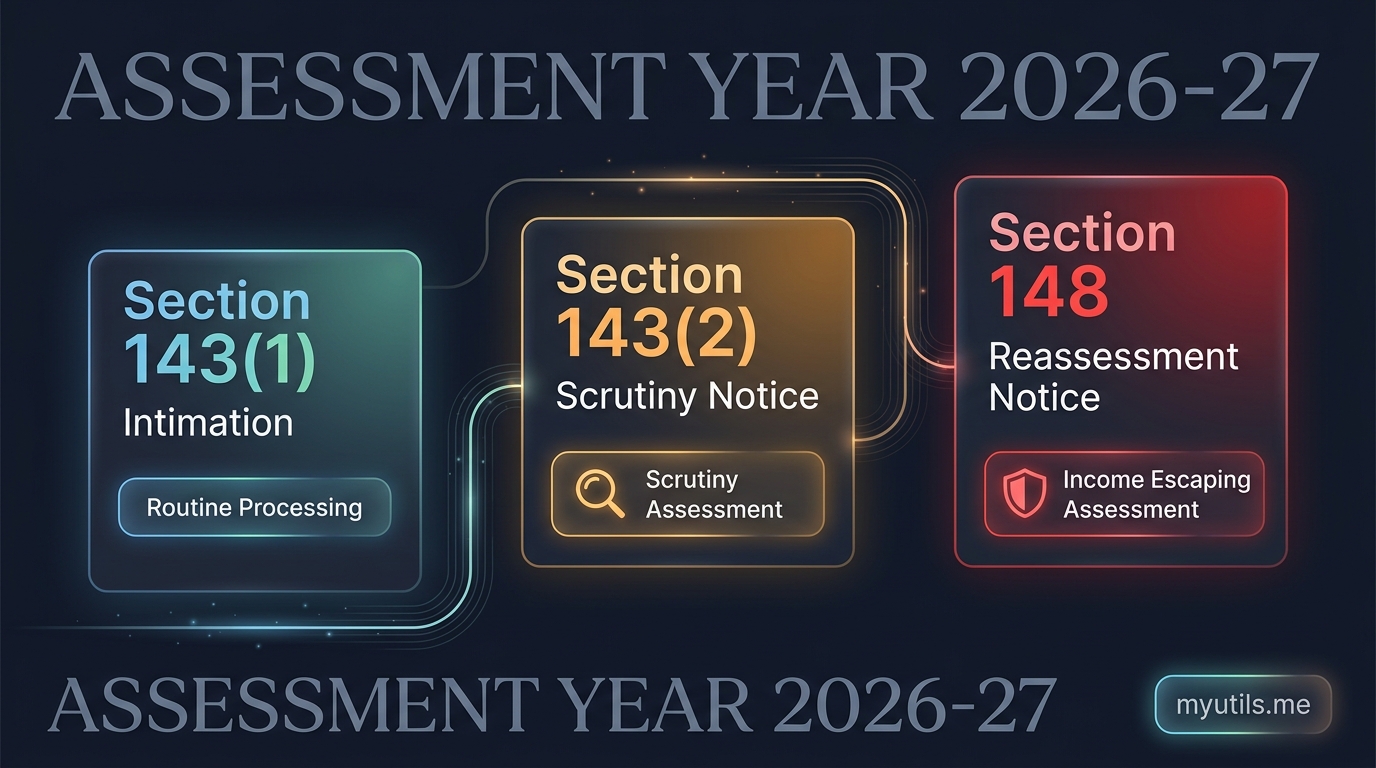

For decades in Indian taxation, missing the December 31 deadline for filing a Belated or Revised Return meant doors were firmly shut. If you realized in January that you forgot to report a mutual fund redemption or missed declaring bank interest, you had to wait in dread for an automated notice under Section 148.
That changed with the introduction of Section 139(8A): the Updated Return of Income (ITR-U).
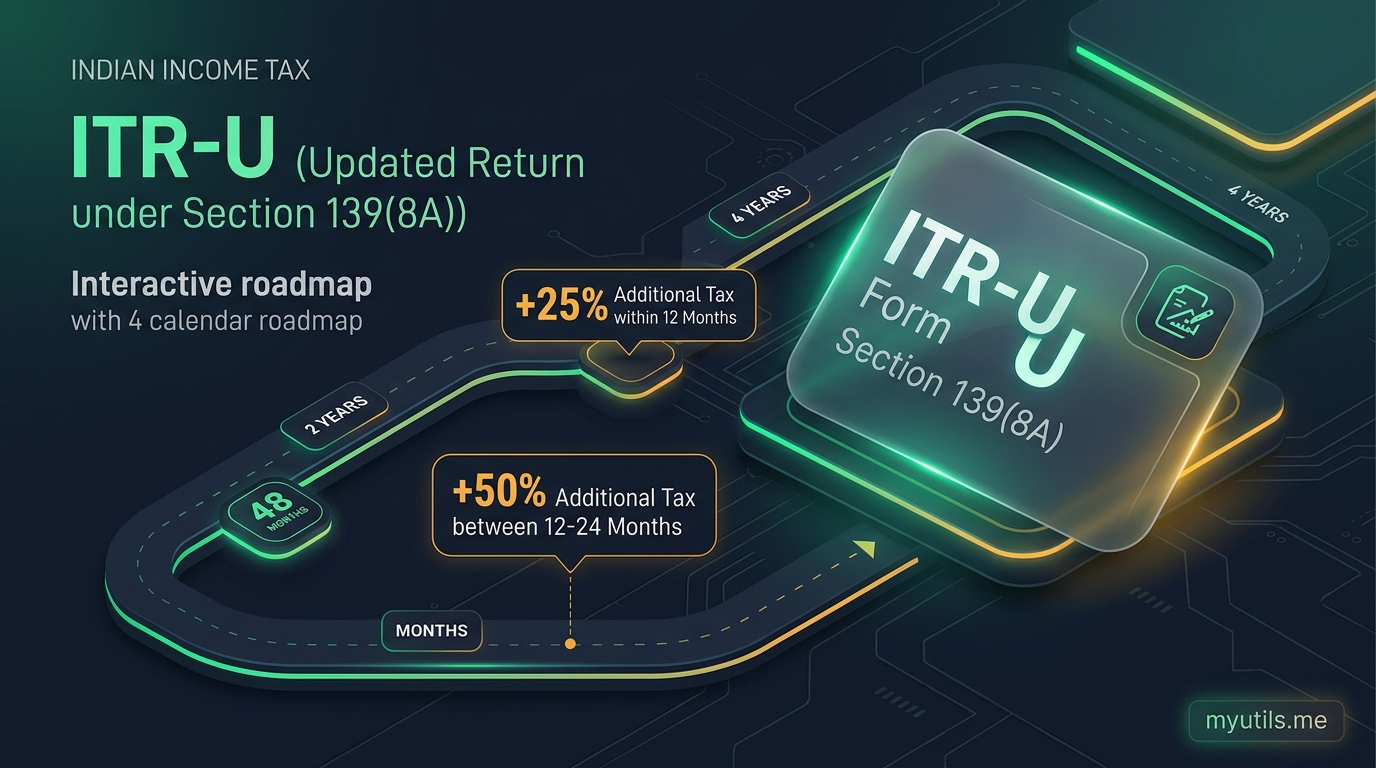
Crucially, under amendments introduced by Finance Act 2025 (effective April 1, 2025), the government has significantly expanded the ITR-U compliance window from the original 24 months to 48 months (4 full years) from the end of the relevant Assessment Year.
This 4-year statutory window provides taxpayers with an unprecedented opportunity to correct omissions, declare previously overlooked income, and avoid invasive reassessment proceedings. Under the new Income Tax Act, 2025 (effective from April 1, 2026), these updated return provisions are codified under Section 263(6).
However, ITR-U remains strictly a one-way street for the revenue. You cannot use ITR-U to claim a tax refund, lower your tax liability, or report a loss.
In this guide, we break down who is eligible to file ITR-U, the step-by-step additional tax penalty calculation under Section 140B, and the legal traps to avoid.

What Is ITR-U Under Section 139(8A)?
An Updated Return under Section 139(8A) is a special statutory filing that enables any person—whether they previously filed an original, belated, or revised return, or failed to file any return at all—to submit an updated disclosure of their total income.
Permissible Reasons to File ITR-U
When filling out Part A of Form ITR-U, you must select one of the authorized statutory reasons for updating:
- Return previously not filed: You completely missed the original July 31 and belated December 31 deadlines.
- Income not reported correctly: You omitted foreign dividends, interest on fixed deposits, or capital gains.
- Wrong heads of income chosen: You reported intraday or futures & options (F&O) trading under Capital Gains instead of Business Income.
- Reduction of carried forward loss: You mistakenly carried forward a higher loss than permitted.
- Reduction of unabsorbed depreciation or MAT/AMT credit.

When You CANNOT File ITR-U (Critical Restrictions)
The most common mistake taxpayers make is attempting to use ITR-U to fix a missed refund or rectify an overpaid tax liability. The statute explicitly prohibits ITR-U under the following circumstances:
| Restriction | Why ITR-U Is Prohibited |
|---|---|
| Cannot Result in a Tax Refund | You cannot use ITR-U to claim or increase a tax refund under any circumstances. |
| Cannot Decrease Tax Liability | The updated return cannot result in lower tax liability than what was determined in your previously filed return. |
| Cannot Be a Return of Loss | You cannot submit a nil-tax loss return or convert an earlier declared profit into a net loss. |
| Search & Seizure (Section 132) | Prohibited if a raid, search, or requisition has been initiated against you. |
| Survey Conducted (Section 133A) | Prohibited if a survey was conducted on your premises for that financial year. |
| Ongoing Assessment / Reassessment | Prohibited if scrutiny, reassessment, or revision proceedings are already pending or finalized. |
| Already Filed Once for that AY | You are allowed to file only one ITR-U per Assessment Year. Once filed, you cannot revise an ITR-U. |
Tired of Logging into the Tax Portal for Every Single PAN?
Track all your client and family ITR refund statuses, intimation notices, and AIS summaries from one clean, automated dashboard.
The Cost of Filing: 4-Tier Additional Tax Under Section 140B
Because ITR-U is a voluntary amnesty mechanism, the government levies a mandatory Additional Tax penalty under Section 140B over and above regular income tax, surcharge, cess, and interest under Sections 234A, 234B, and 234C.
Following the enactment of Finance Act 2025, the statutory timeline spans 48 months (4 years) across four distinct penalty tiers:
| Filing Window (From End of Relevant AY) | Additional Tax Penalty u/s 140B | Compliance Status |
|---|---|---|
| 0 to 12 Months | +25% of (Tax + Accumulated Interest) | Active Window (Tier 1) |
| 12 to 24 Months | +50% of (Tax + Accumulated Interest) | Active Window (Tier 2) |
| 24 to 36 Months | +60% of (Tax + Accumulated Interest) | Active Window (Tier 3 - Enacted FA 2025) |
| 36 to 48 Months | +70% of (Tax + Accumulated Interest) | Active Window (Tier 4 - Enacted FA 2025) |
| Beyond 48 Months | Not permitted under Section 139(8A) | Permanently Closed |
Realistic Example of Tax Calculation u/s 140B Across Tiers
Suppose an investor omitted ₹5,00,000 in short-term capital gains, resulting in base tax of ₹75,000. Here is how the total cost escalates across the 48-month window:
Tier 1: Filing Within 12 Months (e.g., within Year 1)
- Base Tax: ₹75,000
- Accumulated Interest (234A/B/C): ₹15,000
- Subtotal: ₹90,000
- Additional Tax u/s 140B (25%): 25% of ₹90,000 = ₹22,500
- Total Amount Payable: ₹90,000 + ₹22,500 = ₹1,12,500
Tier 2: Filing Between 12 to 24 Months (e.g., Year 2)
- Base Tax: ₹75,000
- Accumulated Interest: ₹27,000
- Subtotal: ₹1,02,000
- Additional Tax u/s 140B (50%): 50% of ₹1,02,000 = ₹51,000
- Total Amount Payable: ₹1,02,000 + ₹51,000 = ₹1,53,000
Tier 3: Filing Between 24 to 36 Months (e.g., Year 3)
- Base Tax: ₹75,000
- Accumulated Interest: ₹39,000
- Subtotal: ₹1,14,000
- Additional Tax u/s 140B (60%): 60% of ₹1,14,000 = ₹68,400
- Total Amount Payable: ₹1,14,000 + ₹68,400 = ₹1,82,400
Tier 4: Filing Between 36 to 48 Months (e.g., Year 4)
- Base Tax: ₹75,000
- Accumulated Interest: ₹51,000
- Subtotal: ₹1,26,000
- Additional Tax u/s 140B (70%): 70% of ₹1,26,000 = ₹88,200
- Total Amount Payable: ₹1,26,000 + ₹88,200 = ₹2,14,200
Important Rule: Proof of payment of this additional tax (via Challan ITNS 280 under Major Head 0021 and Minor Head self-assessment with Section 140B) must be entered into the ITR-U utility prior to submission. Unlike normal returns, you cannot submit ITR-U and pay taxes later.

Step-by-Step Guide to Filing Form ITR-U
Filing an updated return requires preparing both the underlying ITR form (ITR-1, 2, 3, or 4) and Part A & Part B of Form ITR-U:
Step 1: Download the Offline Utility
- Visit incometax.gov.in > Downloads.
- Select the relevant Assessment Year and download the Common Offline Utility (JSON format).
- Open the utility and choose the appropriate ITR form corresponding to your income sources.
Step 2: Fill in the Applicable Schedules
- In the General Information sheet, under filing status, select "139(8A) - Updated Return".
- Fill in all income schedules (Salary, House Property, Capital Gains, Business, Other Sources) showing the total complete income for that year, not just the omitted portion.
Step 3: Complete Schedule ITR-U (Part A and Part B)
- Part A (General Information): Select whether a return was previously filed, provide the original acknowledgment number (if applicable), and select the exact reason for updating from the dropdown.
- Part B (Tax Computation u/s 140B): Enter the additional income, regular tax, interest under Sections 234A/B/C, and compute the applicable 25%, 50%, 60%, or 70% additional tax depending on the filing period.
Step 4: Pay Challan u/s 140B and Input BSR Details
- Go to e-File > e-Pay Tax on the income tax portal.
- Generate an electronic challan. Ensure you select the correct Assessment Year and tax payment type "Tax on Updated Return (Section 140B)".
- Complete net banking payment. Copy the BSR Code, Challan Date, and Challan Serial Number into Part B of your offline utility.
Step 5: Upload JSON and e-Verify
- Generate the verified JSON payload from the offline utility.
- Log in to the e-filing portal, navigate to e-File > Income Tax Returns > File Income Tax Return.
- Select Assessment Year, choose 139(8A), upload the JSON, and immediately e-verify using Aadhaar OTP or DSC.
Key Takeaways
- ITR-U Is for Income Additions Only: Never attempt to file ITR-U to claim an omitted refund or reduce tax; CPC will immediately reject the return as defective.
- Expanded 48-Month Window (4 Years): Under Finance Act 2025, you now have up to 48 months from the end of the relevant AY to voluntarily cure undisclosed income, with tiered penalties of 25%, 50%, 60%, and 70%.
- Only One Chance Per Year: You cannot file a revised ITR-U. Cross-check your Annual Information Statement (AIS) thoroughly to ensure all omitted income is captured in this single filing.
- Transition to Income Tax Act 2025: For filings under the new direct tax framework, updated returns are codified under Section 263(6).
- Automate Multi-Year PAN History: If you manage compliance across multiple family members or client accounts, tracking which historical years have pending AIS gaps is critical. Platforms like myutils.me provide centralized tracking across historical assessment years so you can spot and cure omissions before the tax department initiates Section 148 proceedings.

myutils.me
Tax Compliance Research Team
Official editorial and compliance research team at myutils.me, building automated tools for income tax return tracking, AIS/TIS reconciliation, and direct tax workflows.