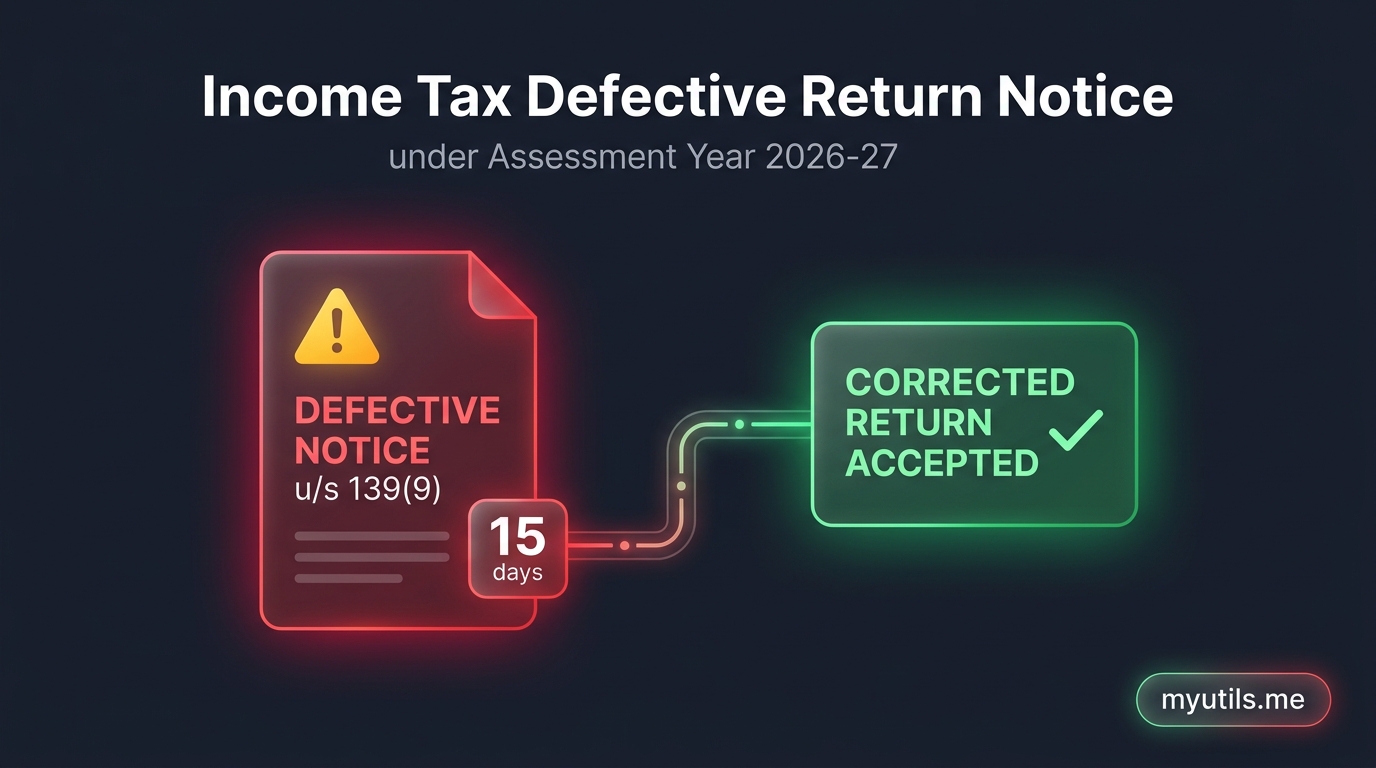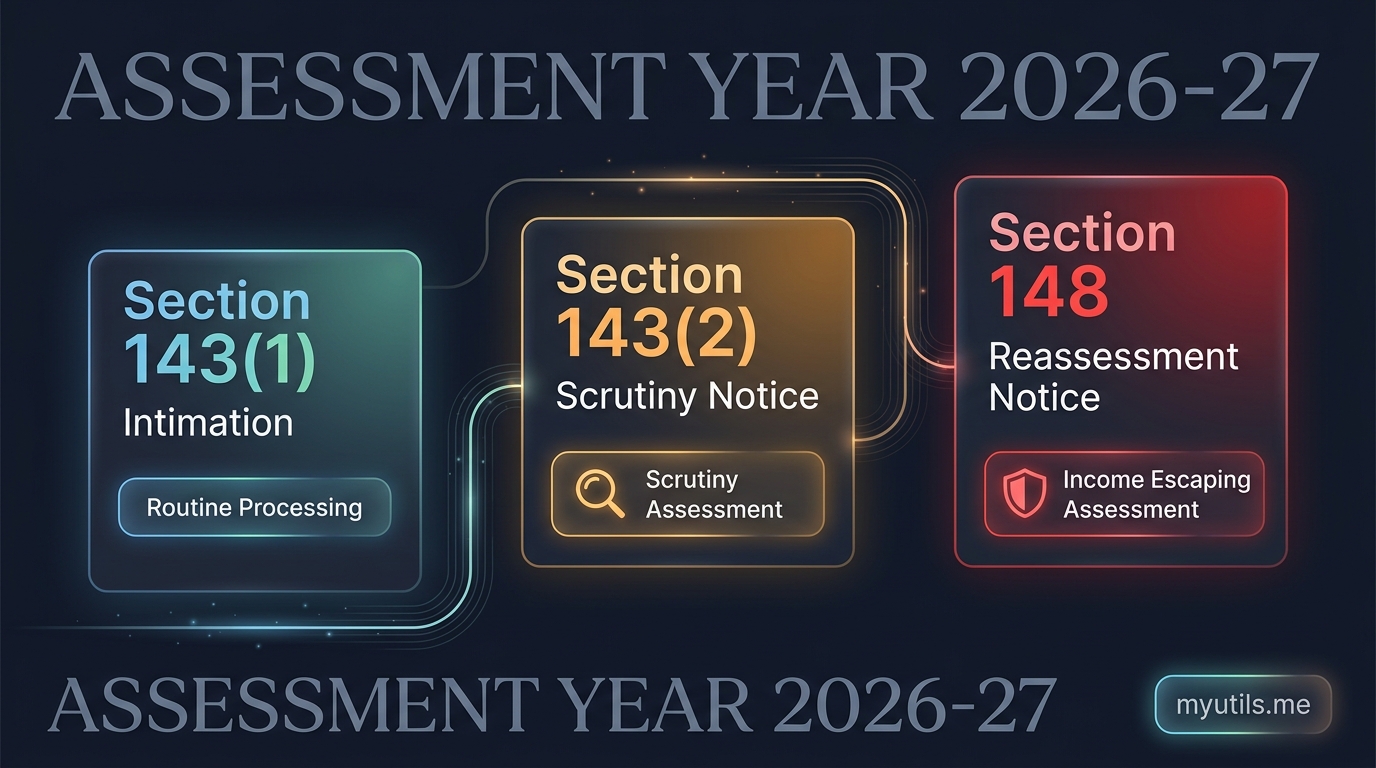

Every year, millions of taxpayers receive automated emails and SMS notifications from the Income Tax Department containing section numbers like 143(1), 143(2), or 148.
For most people, seeing any communication from the tax department triggers immediate alarm. However, the legal weight and implications of these sections are drastically different:
- One is merely a routine mathematical receipt sent to nearly every filer.
- Another is an official in-depth audit (scrutiny assessment).
- The third is a high-stakes investigation alleging that you concealed taxable income.
Understanding which category your communication falls into determines whether you simply save a PDF for your records, submit a minor portal rectification, or immediately engage a Chartered Accountant.
In this guide, we break down the exact differences between Section 143(1), Section 143(2), and Section 148 for Assessment Year 2026-27.

At a Glance: Comparison Table
| Parameter | Section 143(1) | Section 143(2) | Section 148 / 148A |
|---|---|---|---|
| Nature | Summary Intimation / Processing Receipt | Scrutiny Assessment Notice | Reassessment / Income Escaping Notice |
| Trigger | Automatic for every successfully processed return | Algorithmic risk profiling (CASS) or high-value flags | Specific evidence of undisclosed taxable income |
| Issued By | CPC (Centralized Processing Centre, Bengaluru) | National Faceless Assessment Centre (NaFAC) | Jurisdictional AO / Reassessment Unit |
| Department Deadline | 9 months from end of FY in which return was filed | 3 months from end of FY in which return was filed | 3 years (up to 5 years if escaped income ≥ ₹50 Lakh) |
| Taxpayer Action | None (if tax matches), or pay demand / file revised return | Mandatory response with books, invoices & bank statements | Legal reply to show-cause notice u/s 148A, followed by ITR filing |
| Severity Level | Low (routine acknowledgment) | Moderate to High (formal audit) | Very High (potential penalties and prosecution) |

1. Section 143(1): Summary Processing Intimation
What It Is
An Intimation under Section 143(1) is not an audit or scrutiny notice. It is an automated calculation summary generated by CPC algorithms when your e-filed ITR is processed.
Think of it as a side-by-side reconciliation statement: column one shows what you declared in your return, and column two shows what CPC calculated based on internal rules, Form 26AS, and AIS data.
Three Possible Outcomes of 143(1)
- Intimation with No Demand / No Refund: Your tax calculations match CPC's calculations exactly. Your return is officially accepted, and the process is complete.
- Intimation Determining a Refund: CPC confirms you overpaid taxes (via TDS, TCS, or advance tax). The refund amount, along with interest u/s 244A, is queued for direct bank dispatch.
- Intimation with Demand Notice: CPC identified an arithmetic error, disallowed an ineligible deduction, or failed to match a paid tax challan, raising a payable balance.
Statutory Time Limit
The department must issue the 143(1) intimation within 9 months from the end of the financial year in which the return was filed. For example, for an ITR filed in July 2026 (FY 2026-27), the 143(1) intimation must be issued by December 31, 2027.
What You Must Do
- If the intimation shows zero demand, save the password-protected PDF (password is your PAN in lower case followed by date of birth in DDMMYYYY format) in your records.
- If it shows an unjustified demand, determine whether it was a filing omission (rectified via a revised return u/s 139(5)) or a CPC software glitch (rectified via online rectification u/s 154).
2. Section 143(2): Scrutiny Assessment Notice
What It Is
A notice under Section 143(2) indicates that your return has been selected for a formal, detailed examination under the Faceless Assessment Scheme.
Selection is driven by Computer-Assisted Scrutiny Selection (CASS) algorithms, which flag anomalies such as:
- Massive fluctuations in business turnover or gross profit margins compared to prior years.
- Discrepancy between stock trades or capital gains reported in AIS and your declared ITR.
- High deductions claimed under Chapter VI-A (such as 80G donations or 80D medical) disproportionate to declared income.
- Significant foreign assets or foreign income disclosures.
Types of Scrutiny
- Limited Scrutiny: The Assessing Officer only investigates one or two specific parameters (e.g., verifying the purchase cost of a specific property sold during the year).
- Complete Scrutiny: A full audit of all income schedules, balance sheet items, bank accounts, and deduction proofs.
Statutory Time Limit
By law, a Section 143(2) notice must be served within 3 months from the end of the financial year in which the return was furnished. For a return filed in July 2026 (FY 2026-27), the notice must be issued on or before June 30, 2027. A notice served after this statutory cutoff is legally invalid.
What You Must Do
- Do Not Ignore It: Failing to respond will result in a Best Judgment Assessment under Section 144, where the officer assesses tax, interest, and penalties ex-parte.
- Access e-Proceedings: Log in to
incometax.gov.in> Pending Actions > e-Proceedings. - Submit Evidentiary Documentation: Upload detailed ledgers, bank statements, purchase agreements, and tax reconciliations.
- Consult a Professional: Unlike 143(1), handling a 143(2) scrutiny requires professional drafting by a Chartered Accountant to ensure legal submissions protect you from adverse additions.
Tired of Logging into the Tax Portal for Every Single PAN?
Track all your client and family ITR refund statuses, intimation notices, and AIS summaries from one clean, automated dashboard.
3. Section 148 / 148A: Reassessment of Escaped Income
What It Is
A notice under Section 148 is issued when the Income Tax Department has specific, verifiable information showing that you earned income that escaped assessment (unreported or concealed income).
Before issuing a Section 148 notice, the department is legally required to follow the pre-notice procedure under Section 148A:
- Section 148A(b): The officer issues a Show Cause Notice sharing the specific adverse information available with the department (e.g., unexplained cash deposits, undeclared property purchases, unrecorded crypto gains).
- Taxpayer Reply: You are given between 7 to 30 days to submit a written explanation proving that the income was either fully taxed, exempt, or belongs to another entity.
- Section 148A(d) Order: The officer passes a formal order deciding whether it is a fit case to reopen assessment.
- Section 148 Notice: If approved, the formal notice is issued directing you to file a fresh return within 3 months.
Statutory Time Limit (Reassessment Window under Finance Act 2024)
Under the rationalized reassessment framework introduced by the Finance Act (effective for notices issued on or after September 1, 2024), the old 10-year reopening window has been abolished:
- Escaped Income Under ₹50 Lakh: A Section 148A show-cause notice cannot be issued if 3 years have elapsed from the end of the relevant Assessment Year (Section 148 notice capped at 3 years and 3 months).
- Escaped Income of ₹50 Lakh or More: A Section 148A notice can be issued up to 5 years from the end of the relevant Assessment Year if the officer possesses books, documents, or evidence of escaped income (Section 148 notice capped at 5 years and 3 months).
- The previous draconian 10-year reassessment period no longer applies to general reassessments.
What You Must Do
- A Section 148 notice carries severe financial and penal implications, including penalties up to 200% under Section 270A and potential criminal prosecution under Section 276C.
- You should immediately engage a senior tax practitioner or Chartered Accountant to verify the jurisdiction, inspect the underlying information, file the response to the Section 148A(b) show cause notice, and challenge any procedural defects.

Notice Workflow Comparison
| Assessment Stage | Notice / Intimation Issued | Issuing Authority | Taxpayer Response Required |
|---|---|---|---|
| Stage 1: Automated Summary | Section 143(1) Intimation | CPC (Centralized Processing Centre) | None if zero/refund; file rectification u/s 154 or revised return if demand is incorrect. |
| Stage 2: Risk Scrutiny | Section 143(2) Scrutiny Notice | National Faceless Assessment Centre (NaFAC) | Mandatory electronic submission of accounting books, invoices, and bank statements. |
| Stage 3: Assessment Order | Section 143(3) Scrutiny Order | Faceless Assessing Officer | Final order determining total tax liability or additions. Appealable to CIT(A). |
| Stage 4: Escaped Income Inquiry | Section 148A Show Cause Notice | Jurisdictional Assessing Officer | Written submission within 7–30 days contesting allegations of undisclosed income. |
| Stage 5: Reopening Notice | Section 148 Reassessment Notice | Reassessment Unit | Mandatory e-filing of fresh income tax return for the reopened Assessment Year. |
Practical Rules for Staying Notice-Free
- Reconcile with AIS / TIS Before Filing: Ensure every single interest entry, dividend, mutual fund redemption, and property transaction visible in your AIS is reflected in your ITR.
- Never Treat 143(1) as an Audit: If you receive a 143(1) intimation showing zero tax due, you do not need to submit documents. Simply archive the acknowledgment.
- Always Respond Through the Portal: Under the Faceless Assessment framework, no tax officer will call you or visit your home. All valid notices have a unique Document Identification Number (DIN) verifiable on
incometax.gov.in. - Monitor Client PANs Centrally: For tax advisors and families managing multiple files, tracking notices across dozens of logins manually is error-prone. A centralized dashboard like myutils.me automates notice alerts across all tracked PANs so critical deadlines never slip through.

myutils.me
Tax Compliance Research Team
Official editorial and compliance research team at myutils.me, building automated tools for income tax return tracking, AIS/TIS reconciliation, and direct tax workflows.